A European hornet nest is treated the same way as a wasp nest: one visit, the same materials, the same fixed £60. Hornets are wasps — bigger, slower, and considerably better mannered than the common wasp — and there is nothing about the job that justifies charging more for one. The harder part is working out whether you have a hornet at all, because a good share of the calls that come in describing hornets turn out to be something else entirely.
The short version
- Same price. £60 fixed, hornet or wasp, whatever the size of the nest.
- Same visit. Treated at the entrance in one appointment, seven days a week.
- Usually not a hornet. Large common wasps and spring queens account for a lot of hornet calls.
- Night flights are the tell. Only the European hornet forages after dark and comes to lit windows.
- Sometimes no job at all. A hornet nest well away from paths and doors can be left to die back in autumn.
- Asian hornets are different. Notifiable, reported to the authorities, not a private treatment.
Is it actually a hornet?
Start with the night-flying question
This is the single most common reason people ring about hornets, and it is also the most reliable identification test available to a homeowner. The European hornet (Vespa crabro) forages after dark and is strongly attracted to light. What people describe is almost always the same scene: something very large repeatedly hitting a lit bedroom window, a conservatory roof, or a security light on a garage, at ten or eleven at night, with a heavy droning note nothing like the fizz of a wasp.
No other social wasp in Britain does this. Common and German wasps are finished for the day by dusk and will not appear at a lit window at midnight. So if the insect turns up after dark and goes for the light, European hornet is by far the most likely answer.
It is also easy to end. Draw the curtains, or switch the light off for ten minutes, and the visits usually stop. The insect is not trying to get at you; it is disorientated by the light. What it does tell you is that a nest is somewhere in the area — though not necessarily on your property, because hornets forage a fair distance from home.
Then check the size and the colour
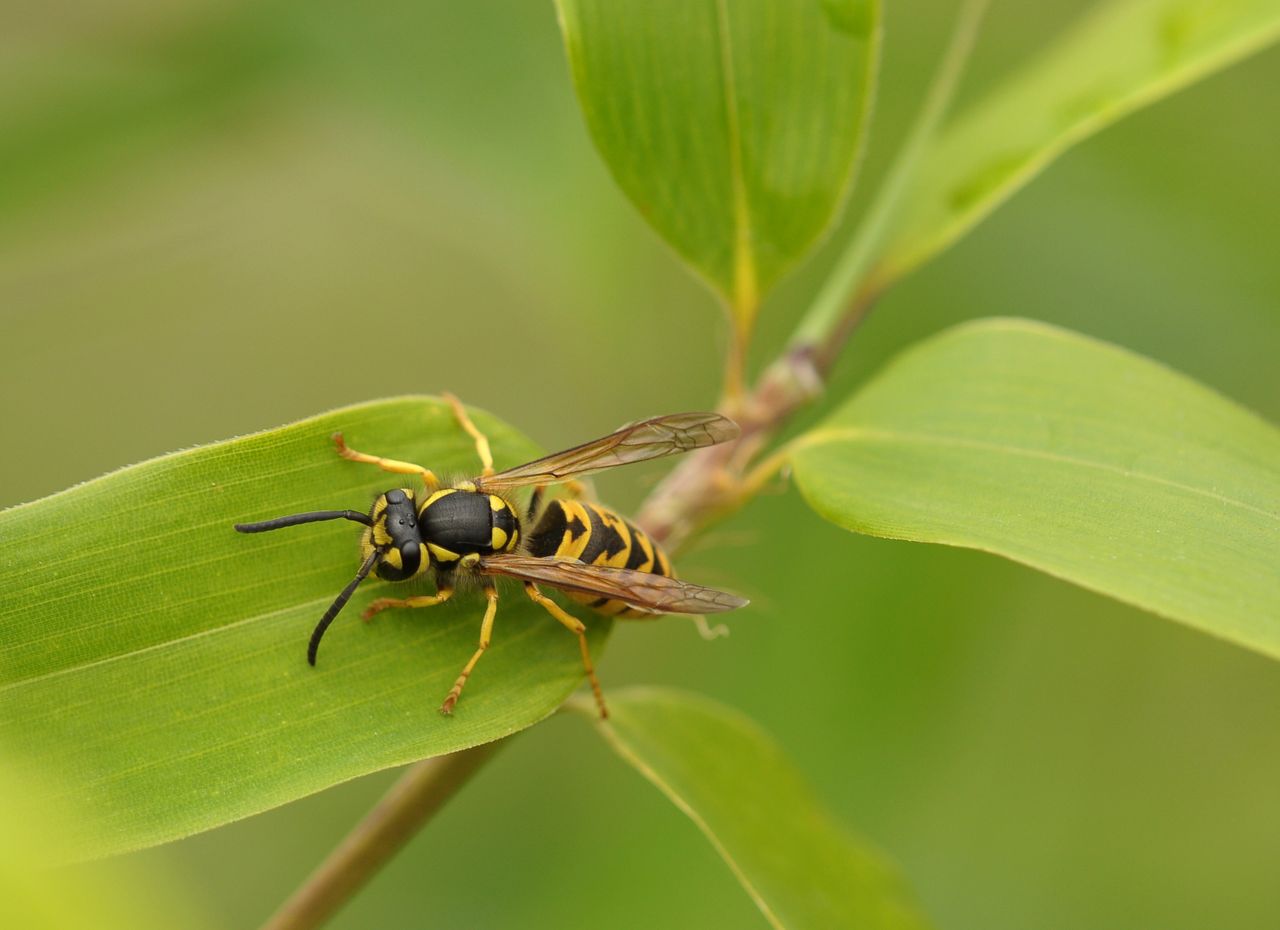
Held against a common wasp, a hornet is roughly twice the insect. The colour is the giveaway that survives a poor photograph: a hornet is yellow with chestnut and reddish-brown, where a common wasp is yellow with hard black. Hornets also look blunter — the waist is less sharply pinched and the abdomen reads as rounder and heavier.
| Feature | European hornet | Common wasp | Hornet-mimic hoverfly |
|---|---|---|---|
| Size | Workers 18–25 mm, queens larger | Workers 12–17 mm | 20–25 mm |
| Markings | Yellow with chestnut / reddish-brown | Bright yellow with black | Chestnut and yellow, no true black |
| Shape | Round, heavy abdomen | Sharply pinched waist | Broad and flat, huge eyes |
| Wings | Four | Four | Two |
| Flight | Slow, deep droning note | Fast, erratic, higher pitched | Hovers, then darts sideways |
| Active at night | Yes, comes to lights | No | No |
| Sting | Yes, repeatedly | Yes, repeatedly | None at all |
In spring, it is probably a queen wasp
From late April through May the insect described as a hornet is very often a common wasp queen. She is around twice the size of the workers that will follow her, flies slowly, bumps into things, and appears alone rather than in numbers — all of which reads as hornet-like. The colour settles it: a queen wasp is the same bright yellow and black as her workers, with no chestnut anywhere on her. She is looking for a nest site, and if she is indoors the sensible response is to open a window and let her out.
And it might have no sting at all
The hornet-mimic hoverfly (Volucella zonaria) is a large, chestnut-and-yellow hoverfly that turns up in gardens in late summer and looks alarmingly like a hornet in a still photograph. It is completely harmless and cannot sting. Two things separate it. It has two wings rather than four, and its eyes are enormous, covering most of the head the way a housefly's do. It also hovers on the spot for seconds at a time, which no wasp or hornet does.
How dangerous is a European hornet, really?
Less dangerous than the size suggests, which surprises most people. The European hornet is markedly more reluctant to sting than a common wasp and will generally carry on with its business while you stand and watch it. Away from the nest it is not defensive at all — a hornet working over ivy flowers or a fallen apple can usually be left to it.
The nest entrance is a different matter. Like any social wasp, hornets defend the colony, and the practical guidance is straightforward: stay a few metres clear of the entrance, and never stand in the flight line, the invisible corridor of traffic in and out. Vibration is the other trigger. Hammering, drilling, strimming or a lawnmower run past a nest in a wall or a hollow tree will provoke a response where simply walking past would not.
The sting itself is more painful than a wasp sting, mainly because a larger insect delivers more venom. For most people the treatment is the same as for any sting, and the NHS page on insect bites and stings covers it properly. Anyone who has had a bad reaction to a sting before, or who carries an adrenaline pen, should treat a hornet exactly as seriously as a wasp and keep well away from the nest. If you have already been stung, our sting first aid guide walks through what to do and the signs that mean you should call 999.
Where hornet nests turn up around here
European hornets are a woodland insect that has adapted to buildings, and the pattern across the greener parts of WA14 and WA16 reflects that. They want a dark, dry cavity with a defensible entrance, and they will use the following:
- Hollow trees. The classic site. Mature oaks and beeches with a rot hole or a split limb, common in the estate parkland and old field boundaries around Dunham Massey, Ashley and Rostherne.
- Stables and outbuildings. Timber-framed tack rooms, hay stores and stable roof spaces on the horse properties out towards Mere and Knutsford.
- Log stores and woodpiles. A stacked log store against a garden wall is a hollow tree as far as a hornet is concerned.
- Roof voids of older stone and timber buildings. Converted barns, coach houses and the older brick and stone properties in Bowdon and Dunham Woodhouses, usually entering under a slipped slate or at a gable end.
- Disused chimneys and flues. Particularly where a fireplace has been capped but the stack left open.
- Wall cavities. Entering through an air brick, a rotten window frame, or the gap around old external pipework.
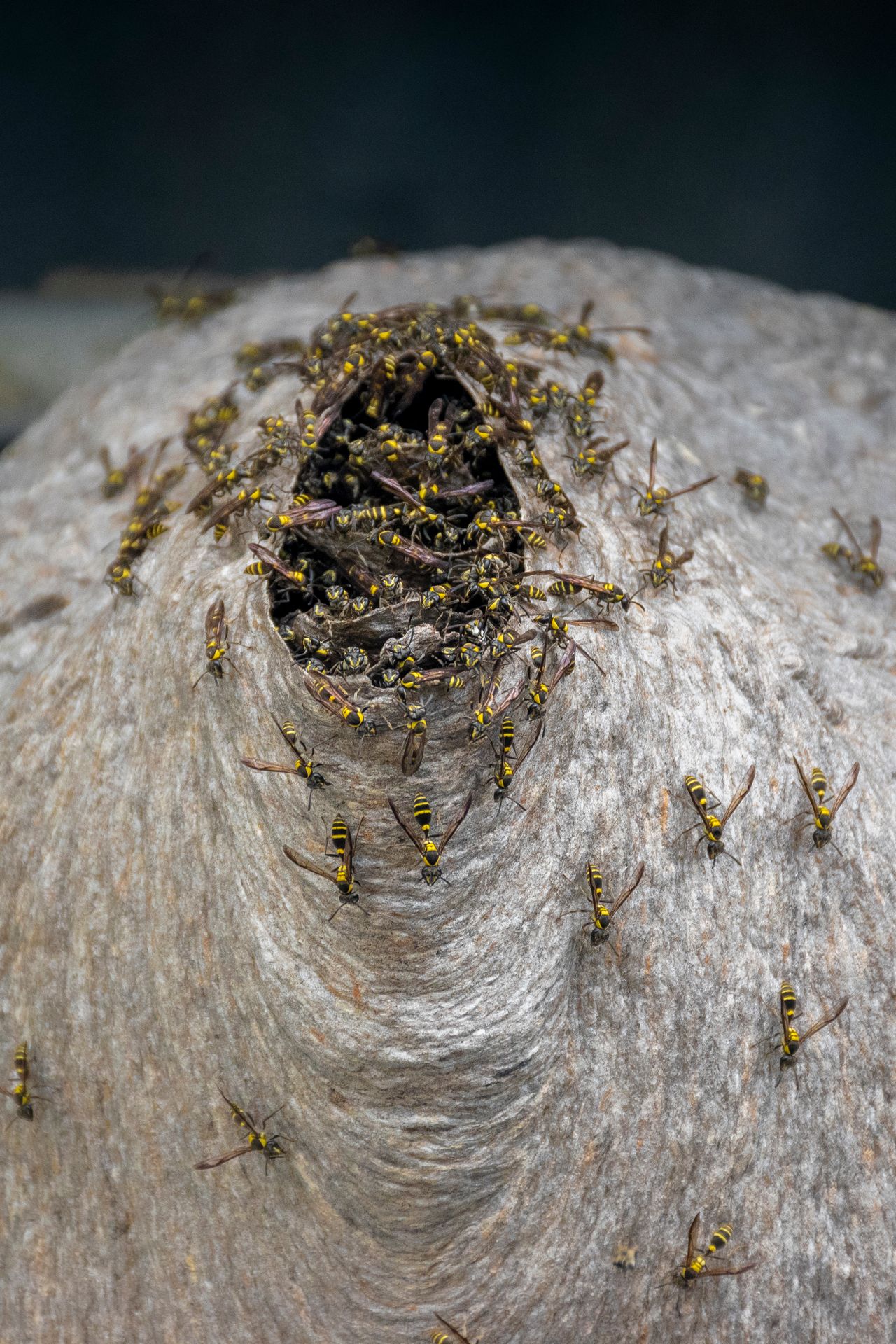
Two things follow from that list. First, hornets are much rarer in the dense terraced and semi-detached streets of central Altrincham than they are half a mile out into the parkland and lanes. Second, you will rarely see the nest itself, because it is built deep inside the cavity. The flight line at the entrance is usually all there is to look at, and that is all we need.
What the job involves, and what it costs
£60 fixed, the same as a wasp nest. No call-out fee, no surcharge for a large nest, no extra for a ladder. The treatment is the same too: an insecticidal dust applied at the nest entrance, which the returning hornets carry inside on their bodies and spread through the colony. It works because the insect does the distribution for us, which is why nobody needs to open up a wall or fell a tree.
Activity usually drops off within a few hours and stops within a day or two. There is no need to seal the entrance afterwards, and no need to remove the nest — an old hornet nest is empty by autumn and is never reused. If the nest is still live after treatment, we come back and redo it at no charge.
One honest note on colony size. A hornet nest holds a few hundred insects, where a common wasp nest at August peak holds several thousand. The hornets are larger and the noise is more impressive, but there are far fewer of them, and the job is generally less dramatic than the size of the insect leads people to expect.
When you should leave it alone
Plenty of hornet nests do not need treating, and it is worth saying so plainly. If the nest is in a hollow tree at the bottom of a large garden, in a woodland boundary, or in an outbuilding nobody uses, and no one has to walk within a few metres of the entrance, leaving it is a perfectly sound decision. The colony dies out through October, the nest is never used again, and hornets are useful predators of the flies and caterpillars you would rather not have.
Treat when the nest is genuinely in the way: over a back door, beside a path or a play area, in a stable or a working outbuilding, inside a roof void above a bedroom, or where someone on the property has a known sting allergy. Those are the cases where the risk is real. A hornet nest a hundred metres away in a tree is not one of them.
Asian hornets are a different matter entirely
The Asian hornet (Vespa velutina) is a non-native species and is notifiable in the UK. It is not something a private pest controller treats, and we would not attempt to. Suspected sightings are reported to the GB Non-Native Species Secretariat, and confirmed nests are dealt with by the National Bee Unit as part of the national response.
It is a visibly different insect from the native hornet. It is slightly smaller, much darker — the body reads as near-black and velvety rather than chestnut — with distinctly yellow lower legs and a single orange-yellow band towards the rear of the abdomen. It does not fly at night, so the thing at your lit window is not one.
- Report through the Asian Hornet Watch app. Free, for iPhone and Android, and it handles the photo and location for you.
- Or email alertnonnative@ceh.ac.uk with a photograph and the location.
- Or use the online form at the GB Non-Native Species Secretariat.
- Do not approach or treat a suspected nest. Photograph the insect if you safely can, from a distance, and let the response team handle the rest.
If you send us a photograph and it looks like an Asian hornet, we will tell you and point you at the reporting route rather than book a job. That is the correct answer and it costs you nothing.
Not sure what you have?
Take a photo of the insect and, if you can do it safely from a distance, a second photo of the spot they are flying in and out of. Send both to 07770 015197 or through the contact form. We will tell you what it is and whether it needs treating at all — and if the answer is that you can leave it, that is what we will say.
Hornet nest somewhere it shouldn't be?
£60 fixed fee, same-day across Altrincham and Trafford. Hornets are priced exactly like wasps — the size of the nest makes no difference to the bill.
Call to BookFrequently Asked Questions
A European hornet nest costs £60, the same fixed fee as a wasp nest, with no call-out charge and no premium for the size of the nest. Hornets are a type of wasp and the treatment is identical, so there is no honest reason to charge more for one. That price includes the visit, the treatment, and a return visit if the nest is still active afterwards.
A European hornet is roughly twice the size of a common wasp and its markings are yellow with chestnut or reddish-brown, not yellow with black. The abdomen looks rounder and less sharply pinched at the waist, and the flight sound is deeper and slower — you usually hear a hornet before you see it. Hornets also fly after dark; common wasps do not.
That is almost certainly a European hornet. They are the only large social wasp in the UK that forages after dark, and they are strongly drawn to lit windows, security lights and conservatory glass. Turning off or curtaining the light usually ends the visits within minutes. It tells you a nest is somewhere nearby, but not where.
Less than their size suggests. European hornets are noticeably more reluctant to sting than common wasps and generally ignore people who are not near the nest. They will defend the nest entrance, and the sting is more painful than a wasp sting because more venom is delivered. Anyone with a known sting allergy should treat a hornet exactly as seriously as a wasp.
No. If the nest is in a hollow tree or an outbuilding at the far end of a garden and nobody has to walk past the entrance, leaving it alone is a perfectly sound decision. The colony dies out in autumn and the nest is never reused. Treatment is worth it when the nest is on a doorway, a path, a stable, or inside a roof.
European hornets nest in cavities rather than in the open. Hollow trees are the classic site, followed by log stores, stables, disused chimneys and the roof voids of older stone and timber buildings. The nest itself is papery and brownish, often built deep inside the cavity where you cannot see it, so the flight line at the entrance is usually the only visible sign.
Report it rather than treating it. The Asian hornet is a notifiable non-native species in the UK, and suspected sightings go to the GB Non-Native Species Secretariat through the Asian Hornet Watch app or by email to alertnonnative@ceh.ac.uk. A photograph helps enormously. A suspected Asian hornet nest is handled by the National Bee Unit, not by a private pest controller.
No. Treatment destroys the colony, and there is no practical way to lift an established hornet nest out of a wall or a tree cavity intact. The honest alternative is not to treat at all — if the nest is somewhere you can genuinely keep away from until autumn, leaving it is the better answer.