If a nest has stopped a job, what you need is a same-day visit. We attend trade and commercial callouts across Altrincham and Trafford seven days a week, treat wasp, hornet and bumblebee nests on a fixed fee, and invoice the company rather than asking whoever is on site to find a card. The treatment is not the expensive part of the morning. Four people stood by a van at ten o'clock is.
The maths nobody puts in the quote
A roofing crew that pulls a soffit at half eight and finds a nest behind it has three choices: work round it, pack up, or get it treated. Working round it is how people get stung on a ladder. Packing up writes off the day and pushes everything behind it — the scaffold hire, the plasterer booked for Thursday, the client who has taken a day off work.
Getting it treated on the same day is nearly always the cheapest of the three, and it is not close. That is the whole argument for this page. For a domestic caller the question is what it costs. For a site manager the question is what time we can be there.
What the crew should do in the first ten minutes
Most of the serious incidents happen after the nest is found, not before. Wasps that have been quietly ignoring a working roof will defend hard once the nest is disturbed, and a person on a ladder or a scaffold lift has nowhere sensible to go. In order:
- Come down, calmly. Do not swat, do not run along a scaffold board. Walk away steadily. Wasps chase movement, and they lose interest at distance far more readily than they lose interest in flailing.
- Clear ten metres and keep people out. Cone it, tape it, tell the rest of the site. If the nest is above a walkway or a welfare unit door, reroute the walkway rather than trusting everyone to remember.
- Do not spray it. A tin of aerosol from a builders' merchant rarely reaches the colony inside a cavity. What it does reliably is soak the guard wasps at the entrance and trigger a full defensive response, at head height, with someone still up a ladder.
- Do not knock it off. Not with a scaffold pole, not with a rake, not with a jet wash. A nest knocked down is a colony released, not a colony killed, and the workers stay in the area for days.
- Do not seal the entry point. Foam or mortar over the hole and several thousand wasps will chew laterally through plasterboard, insulation or a ceiling to get out — often into the room below.
- Do not carry on working above it. Vibration through tiles, battens or a soffit board reads to the colony exactly like an animal digging at the nest.
- Ring it in. Tell us the trade, what came off, roughly where the nest is and whether anyone has already been stung. That is enough to plan the visit.
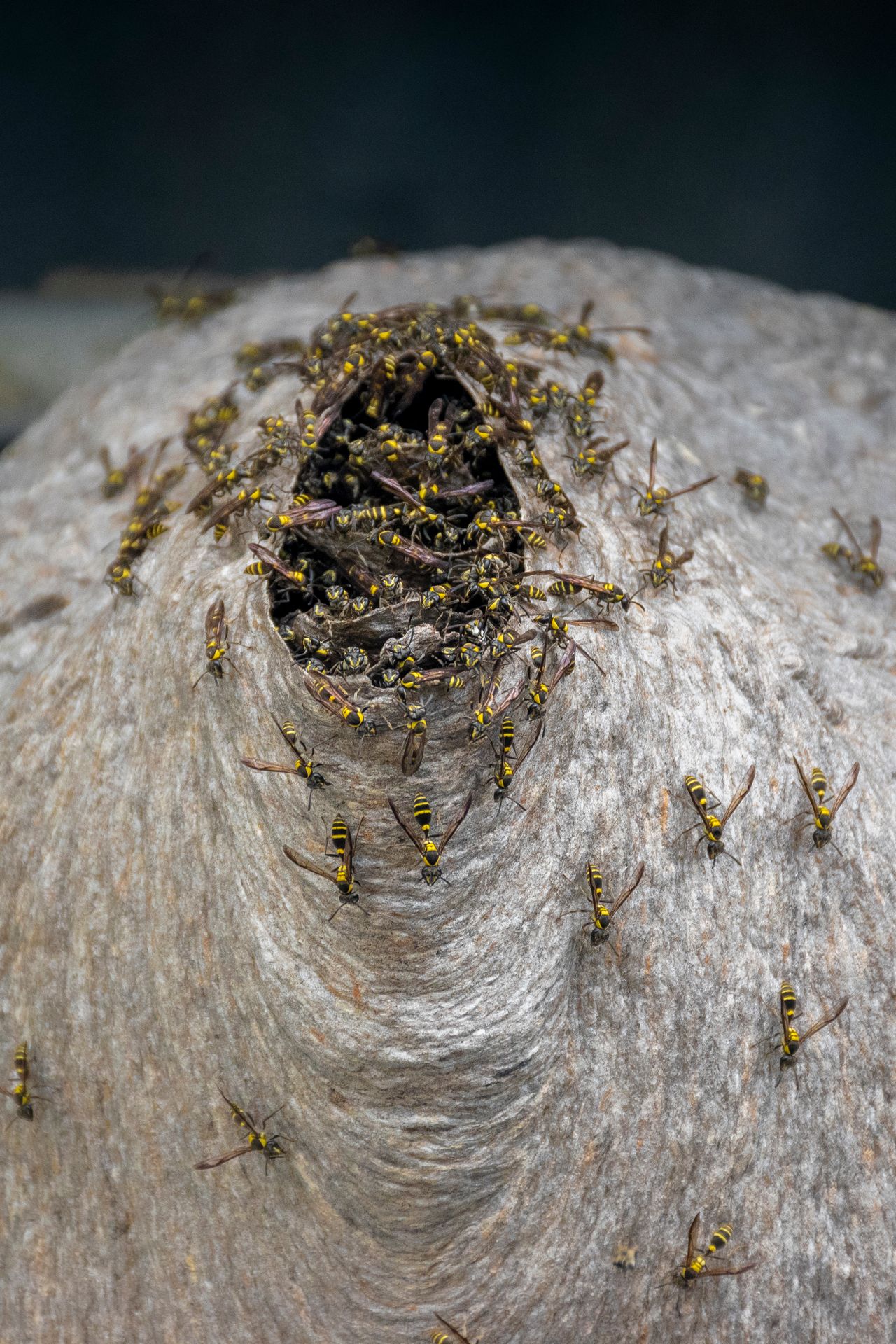
The trades that hit nests, and where
Nests turn up in the same places on the same jobs. Almost always at the moment something gets opened up:
- Roofers and tilers. A slipped or lifted tile is the single most common wasp entry on a house. The nest is usually sat on the felt or in the void immediately behind it, and it is found the moment the tiles come up.
- Fascia, soffit and guttering fitters. Second most common by a distance. Old timber soffits with a split or a gap at the corner are exactly the cavity a queen looks for in April, and the nest is discovered as the board comes away.
- Scaffolders. Often the first trade on site and the first to disturb a nest at eaves height, sometimes before anyone has looked at the roof properly.
- Solar PV installers. Nests under existing panels, in the roof void reached through the mounting penetrations, or behind a ridge tile on the run.
- Loft insulation and spray foam crews. The worst discovery of the lot, because you are inside the void with the nest and the exit is behind you. Come down the ladder and leave the hatch shut.
- Window and door fitters, and joiners. Cavity nests found on removing a frame, particularly on older properties where the entry is a perished mortar joint or a redundant vent.
- Groundworkers and landscapers. Ground nests in old rodent burrows, under decking, in banks and under sleepers. These are found by a strimmer or a digger bucket, which is a bad way to find one.
Pubs, cafés and anywhere with outside seating
The trade drops off a cliff when customers stop sitting outside, and in the first week of September that can happen in a single warm weekend. What changes is the wasps' diet, not their numbers.
Through the summer the colony is rearing larvae, and the workers spend their day hunting protein — flies, caterpillars, aphids. They have very little interest in people. By late August the queen has stopped laying, the last larvae have pupated, and several thousand adult workers are left with no grubs to feed and nothing to do. They switch to sugar. That is when they arrive at the tables: cider, cask ale, cordial, fruit, ice cream, the lot.
Here is the part that saves people money. In most pub and café callouts, the tables are not the problem — they are the symptom. The actual draw is usually one of three things behind the scenes:
- The glass returns. A stillage of unrinsed glasses in the sun is the strongest sugar source on the premises, and it sits fifteen metres from the seating.
- The bin store. Particularly the mixed recycling and anything holding fruit waste or draught line flushings.
- An actual nest on the building. Often in a flat roof edge over a kitchen, a disused flue, or the soffit above the smoking shelter.
If it is a nest, treating it clears the problem. If it is the glass returns, no treatment on earth will fix it and we will tell you that rather than take the booking — rinse the glasses, get a lidded stillage, move the bin store away from the seating and shut the lids. We would rather say so on the phone than turn up, treat nothing and invoice you for it.
Nurseries, schools, care homes and community buildings
These sites have the same nest problem as everyone else and a much harder scheduling problem. A treated nest stays busy for a while — foragers return to a nest that is no longer functioning and mill about the entry point before dying off. You do not want that happening over a nursery garden at pick-up time.
So the sensible arrangement is attendance outside opening hours: early morning, after closing, or at a weekend, so the area can stay clear while activity settles. Say when you book that it is a nursery, school or care setting and we will work to the timetable rather than the diary.
A site manager closing the job off in a maintenance log generally needs three things, and all three are straightforward: an invoice, a written record of what was treated and exactly where on the site it was, and our public liability cover figure, which is £2,000,000. Ask and you get all three in writing.
Letting agents, managing agents and landlords
Managed property is mostly an administrative problem rather than a technical one. The fee is fixed and published, so there is no quote to obtain, no site survey to arrange and nothing to approve before the work can be booked. Give us the tenant's name and number and the property address, we arrange access directly with the tenant, and the invoice goes to the agency with the property reference on it.
Worth knowing: the tenant does not need to be home for an external nest. Most eaves, soffit and roof nests are treated entirely from outside, so a job on a tenanted property often needs nothing more than a phone call to let them know we are coming and to keep windows shut on that elevation for a couple of hours.
More than one nest on a site
It happens, particularly on larger buildings and on sites with a long run of old timber eaves. Each nest is treated and charged separately at the same fixed rate, on the same visit — there is no bulk discount and no escalating survey fee either. If we find a second nest that you did not know about, we will say so and price it before touching it, not after.
What we do not do, plainly
Worth being straight about the limits before you put us in a supply chain or a maintenance schedule:
- Wasps, hornets and bumblebees only. Hornets are treated exactly as wasps are and at the same price. Bumblebee nests are a different fixed price.
- No general pest control. No rats, mice, cockroaches, bedbugs, ants, fleas, moths, moles or birds. If your site needs a pest contract, engage a full-service firm — we are not one.
- On-site treatment, done in one visit. Wasp, hornet and bumblebee nests are all dealt with by treating the nest where it is — quick, safe, and with the site left clear to work in.
- Honeybees are somebody else's job. If what you have found is a honeybee swarm — a dense hanging cluster of thousands of small brown bees, usually on a branch or a fence post — a local beekeeper may collect it. That is a beekeeper's call, not a treatment.
The paperwork you can actually have
Procurement teams and site managers reasonably ask what documentation comes with the job. The honest list is short and it is real:
- An invoice to the company, agent or landlord, with a purchase order reference if your system needs one.
- A written record of the work — what was treated, where on the site it was, and the date and time of attendance.
- Public liability cover of £2,000,000, confirmable in writing before we attend if your site induction requires it.
What you will not get, because it would not be true: we are not a member of a pest control trade body, we hold no accreditation scheme logos, and we are not on anybody's approved-contractor register. Plenty of firms put those badges on a van. If your procurement process genuinely requires trade body membership, we will not clear it, and you should use someone who will.
When you do not need to ring anyone
Three situations where a callout is money wasted, and we would rather tell you now:
- A bumblebee nest that nothing is working near. Bumblebee colonies are small, they sting only under real provocation, and they die back naturally by late summer. If the nest is not in the working area, leave it — it will sort itself out.
- A grey papery nest with no traffic at the entrance. Wasp nests are single-use. An old one in a loft or a garage is empty, will not be recolonised, and can be taken down and binned by anyone. Watch the entrance for two minutes first: no wasps in or out means no colony.
- A handful of wasps around a bin with no nest on site. Foragers travel a few hundred metres. Sorting the bins fixes it; treating a nest you have not found does not.
Crew stood down, or a beer garden emptying out?
Same-day attendance across Altrincham and Trafford, seven days a week, £60 fixed and invoiced to the company. Ring 07770 015197 and tell us what you have found — if it is not a job for us, we will say so on the call.
Call to BookFrequently Asked Questions
Yes, same-day attendance is the normal arrangement for trade callouts. Ring as soon as the nest is found rather than at the end of the shift — a morning call across Altrincham and Trafford can usually be seen the same working day, and the sooner the treatment goes in the sooner the crew can get back up there.
It is the same fixed fee as a domestic job — £60 for a wasp or hornet nest, £70 for a bumblebee nest. There is no separate commercial rate, no call-out charge on top and no quoting process to sit through. If a site has more than one nest, each additional nest is charged at the same fixed rate on the same visit.
Yes. We invoice the company, agent or landlord rather than asking whoever happens to be on site to hand over a card. Give us the billing name, address and a purchase order reference if your system needs one, and the invoice goes out after the work with a note of what was treated and where.
Come down, move everyone at least ten metres clear, and leave the nest completely alone. Do not spray it, do not knock it off, do not seal the entry point and do not carry on working above it. Most serious wasp incidents on site happen in the ten minutes after discovery, not before.
Yes, out-of-hours attendance is usually the sensible option for a nursery, school or care home. We can attend early, late or at a weekend so the treated area is empty and the wasps have settled before children or residents are back near it. Say so when you book and we will work around the timetable.
Because the colony has stopped rearing larvae. Through summer, workers hunt protein to feed grubs and are largely uninterested in people. By late August and September the queen has stopped laying, there are no larvae to feed, and thousands of workers switch to hunting sugar — which is beer, cider, fruit, cordial and the glass returns.
No. We treat wasp nests, hornet nests and bumblebee nests, and nothing else. No rodents, no birds, no cockroaches, no bedbugs, no ants. If a site needs a general pest contract you will want a full-service pest control firm — we are not that, and it is better you know before you book.
On a live site the practical answer is treatment. A wasp or hornet colony cannot be lifted and moved intact and survive, so treating the nest where it is remains the reliable option. Bumblebees are the exception worth knowing about: where a nest can safely be left to die back on its own we will tell you, and where it genuinely needs dealing with we treat it.